Research & skills

AI in service of
scientific questions

We start from concrete problems, choose methods that fit, and advance through verifiable experiments.

Our research directions

From observations to reliable results

Scientific data is often incomplete, noisy, or too coarse for the task at hand. Data assimilation, generative models, and uncertainty quantification connect observations, priors, and models into interpretable and assessable inferences.
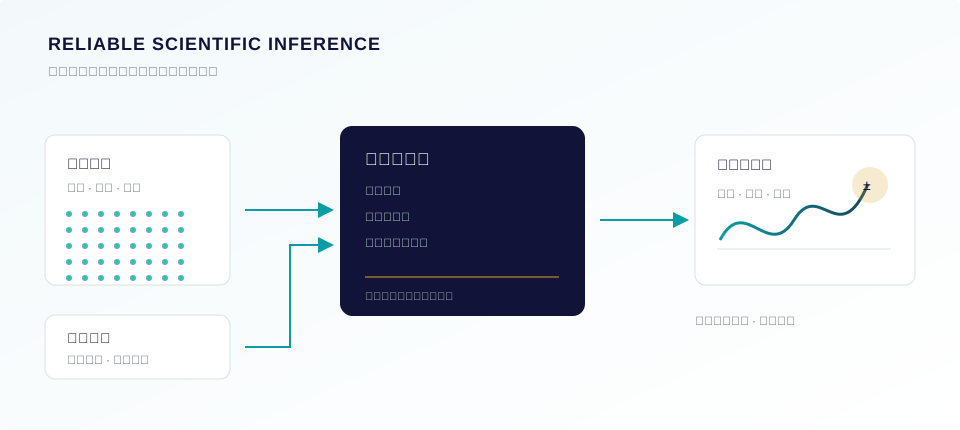
Diagram showing observations, priors, and models producing reliable scientific results
Observations, models, and prior information contribute to scientific inference.

From models to research collaboration

Agentic systems organize models, code, and computational tools into executable research workflows for problem decomposition, experiment design, comparison, and feedback. Each direction contributes to the same process.

Diagram showing an agent organizing models, tools, experiments, and feedback
Agents connect models, tools, experiments, and feedback.

How the directions
work together

Generative models express and recover complex data structures. Data assimilation and optimization combine observations, models, and priors. Uncertainty quantification clarifies the boundaries of results. Agentic systems connect models with computational tools. Together they support verifiable scientific-computing problems.

Skills by direction

The skills are organized around the six research directions, linking methods to the problems they support.